
Writing for Google vs. Writing for AI Answer Engines
I. Two Different Games, Two Different Rulebooks
A. How Google Actually Decides What to Show You
Google’s whole system runs on crawling, indexing, and ranking — three steps that determine whether a page even has a shot at the top of the results. Backlinks and domain authority still carry a lot of weight; PageRank was built on the idea that links are votes of confidence, and that logic hasn’t gone away. And once a page ranks, its position isn’t locked in — click-through rates and how long people actually stick around on the page keep feeding back into where it lands over time.
B. How AI Tools Build Their Answers Instead
Large language models don’t rank a list of pages — they read across several sources and stitch together one answer. That’s a fundamentally different job. Tools like ChatGPT and Perplexity aren’t hunting for keyword density; they care much more about whether the writing is clear, well-structured, and packed with actual facts. A lot of this comes down to retrieval-augmented generation, where the system pulls relevant chunks of source material before it ever starts writing the response.
C. Why One Piece of Content Rarely Wins at Both
Here’s the tension: writing to land in a ranked list of links is a different craft than writing to become the answer itself. Even success looks different — one world measures visits and rankings, the other measures citations and whether you got included in the answer at all. And you can see this play out in the wild: plenty of pages rank beautifully on Google but never get picked up by an AI tool, and vice versa.
II. What Each Format Actually Demands Structurally
A. The On-Page Signals Google Still Cares About
Title tags, meta descriptions, and a clean heading hierarchy are still doing real work — Writing for Google vs AI Answer Engines they tell crawlers what a page is about before a human ever reads a word. Internal linking, sane URL structure, and page speed matter too, especially for keeping rankings stable rather than volatile. And schema markup remains one of the more reliable ways to land a featured snippet or rich result.
B. What AI Systems Look For When Picking Sources
AI tools tend to favor short, direct paragraphs that answer exactly one question —Writing for Google vs AI Answer Engines nothing sprawling, nothing that makes the reader hunt for the point. Numbered lists, definition-style writing, and clear topic sentences all make a passage easier to lift and cite. Even simple question-and-answer formatting inside the body copy noticeably improves the odds of getting pulled into an AI-generated response.
C. Where the Two Approaches Actually Overlap
Some fundamentals just don’t care which channel you’re optimizing for. Core Web Vitals, mobile readiness, and HTTPS are baseline requirements either way. Accuracy, clear sourcing, and keeping information current matter in both ecosystems —Writing for Google vs AI Answer EnginesWriting for Google vs AI Answer Engines nobody’s rewarding stale or sloppy writing. And a well-organized heading structure genuinely helps both a crawler parsing your page and a model trying to understand it.
III. Keywords vs. Topic Authority
A. How Traditional SEO Content Planning Works
Classic SEO starts with research — search volume, keyword difficulty, and user intent all shape which keywords you go after. From there, keywords get mapped to content types: informational, navigational, transactional. And where you place those keywords — in the title, the headers, the body — still meaningfully affects how well a page ranks Writing for Google vs AI Answer Engines.
B. How AI Systems Judge Depth Instead of Frequency
AI tools generally reward thorough coverage of a subject over repeating a keyword a dozen times. That’s pushed a lot of strategy away from chasing individual queries and toward building out full topic clusters instead. Entities, the relationships between concepts, and how semantically complete a piece is all factor into whether an AI system treats it as a trustworthy source Writing for Google vs AI Answer Engines.
C. Building a Strategy That Covers Both
The smart move is research that catches both high-Writing for Google vs AI Answer Engines volume queries and the conceptual gaps an AI tool would need filled in. Write content that works keywords in naturally, but don’t let that come at the cost of depth — AI systems will notice the difference. Mining audience questions, forums, and related search suggestions is a good way to build something that satisfies both.Writing for Google vs AI Answer Engines
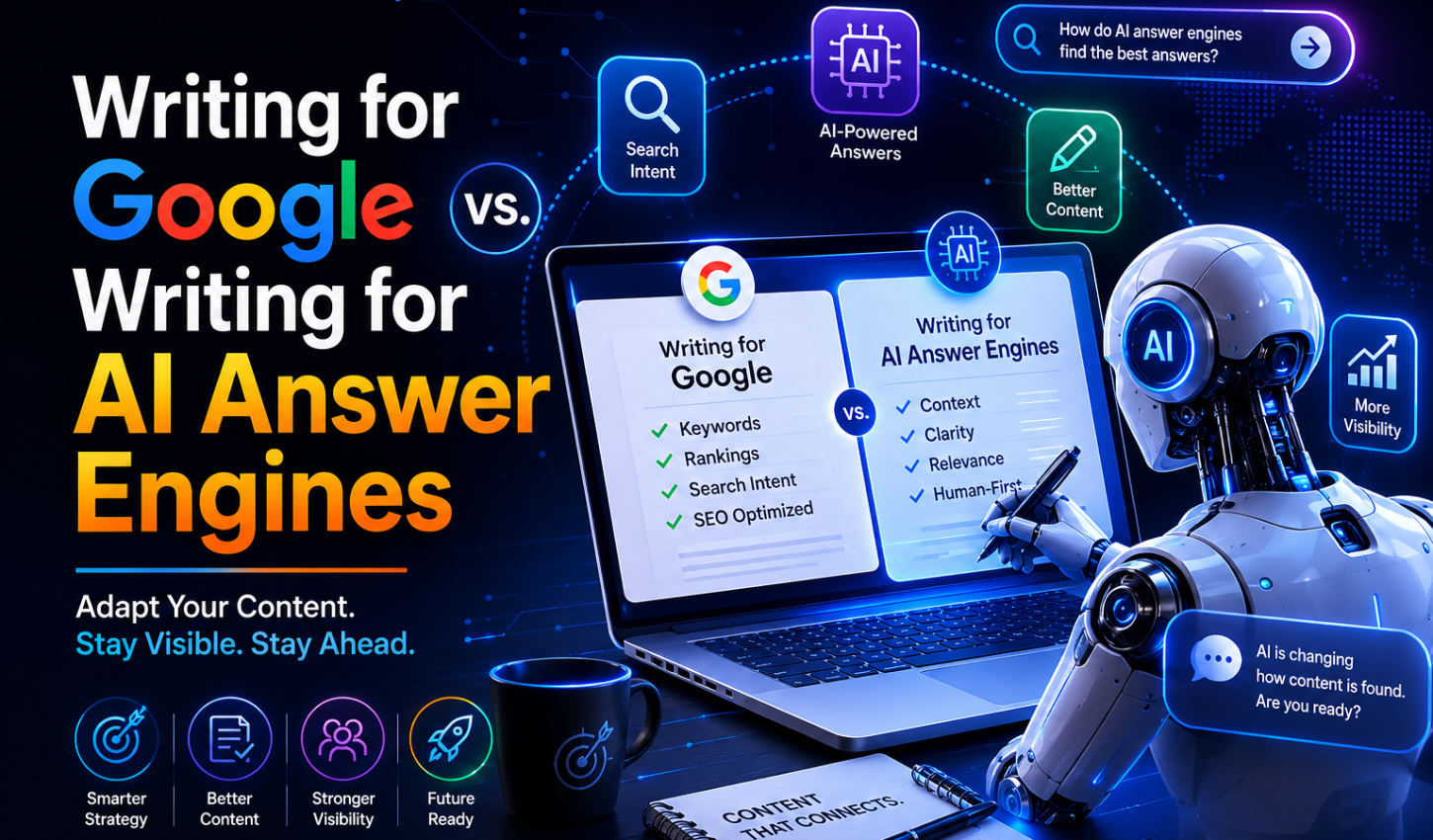
IV. Tone and Style: Writing for Two Different Readers
A. What Earns Rankings and Keeps Human Readers Engaged
A strong intro and a satisfying conclusion do real work—they’re what keep bounce rates down and time-on-page up. Storytelling, real examples, and the occasional analogy make content more readable and more shareable. When it comes to Writing for Google vs AI Answer Engines, the sweet spot is a conversational tone that still carries enough authority to earn backlinks and get picked up editorially.
B. What Gets a Passage Quoted by an AI Tool
Direct, declarative sentences are simply easier for a language model to lift and quote cleanly. That means cutting ambiguous pronouns, vague transitional phrases, and filler that dilutes the precision of a statement. Explicit definitions and clear comparisons that make sense without any surrounding context tend to get cited more often, making them an important part of Writing for Google vs AI Answer Engines.
C. Editing One Draft to Satisfy Both
In practice, this means reading your own draft twice—once as a human reader and once as a retrieval system scanning for extractable answers. Definition-style passages, summaries, and direct answers can usually be placed without breaking the flow of the piece. Callout boxes and pull quotes are useful here too because they let you build dual-purpose sections without disrupting the narrative for readers. This editing approach is one of the most effective ways to improve Writing for Google vs AI Answer Engines.
V. Measuring Whether Any of This Is Working
A. The Metrics That Still Matter for Traditional SEO
Organic traffic, keyword rankings, click-through rates, conversions — these are still the core indicators. Tools like Google Search Console, Ahrefs, and Semrush remain the go-to way to track ranking movement and spot gaps. And when rankings shift, it’s worth learning to read the difference between a normal fluctuation and an actual algorithm update before overreacting.
B. Tracking AI Citations Is Still the Hard Part
Right now, there’s no perfectly reliable way to know when an AI tool is sourcing your content — the tooling is still catching up. Watching for brand mentions, manually querying AI platforms, and using emerging third-party monitoring tools are the closest things we have. Traditional traffic metrics simply don’t capture this, so it’s worth building a separate way to track it.
C. Building a Review Process That Covers Both
A solid content audit schedule should check performance on both fronts — Google rankings and how often you’re showing up in AI answers. From there, you can decide what to prioritize: refreshing for search intent, deepening factual coverage, or restructuring for easier AI extraction. And it’s worth remembering both Google and AI platforms are still actively evolving how they evaluate content, so this isn’t a set-it-and-forget-it process.
Summary
Writing for Google vs AI Answer Engines is no longer a choice between two separate strategies—it’s about understanding how each system discovers, evaluates, and presents content. The gap between writing for Google and writing for AI answer engines like ChatGPT and Perplexity is real, but it’s not as wide as it might seem. Traditional SEO has always leaned on signals like keyword placement, backlinks, and domain authority to earn a spot in a ranked list of links. AI answer engines work on a different logic entirely: they pull from multiple sources and construct a direct response, favoring content that’s precise, factually dense, clearly structured, and easy to lift without needing extra context.
Rather than treating these as two separate disciplines, it’s more useful to identify where they overlap and where they genuinely diverge. Both reward writing that’s accurate, well-organized, and genuinely useful. Both penalize thin, vague, or poorly structured content. The real differences appear in the details—how keywords are used, how sentences are written, how success is measured, and how the structure of a page helps both search crawlers and AI models understand the content.
A successful Writing for Google vs AI Answer Engines strategy combines traditional keyword research with comprehensive topical coverage and clear, scannable formatting. By creating content that ranks well in search while also being easy for AI systems to understand and cite, you can maximize visibility across both channels. As Google Search and AI answer engines continue to evolve, the writers and businesses that adapt to both approaches will be best positioned to stay discoverable, regardless of how their audience chooses to search.
Frequently Asked Questions
Not really. A lot of what makes content strong for one channel — accuracy, clear structure, genuine usefulness — helps the other too. That said, some targeted adjustments to formatting and style can meaningfully boost performance on each side, without needing two entirely separate pieces of content.
That depends on where your audience actually is. If nearly all your traffic comes from organic search today, traditional SEO is still the priority. But if your industry leans heavily on AI tools for research or decision-making, it’s worth investing in AI-friendly structure sooner rather than later.
There’s no fully reliable way yet. The best you can do right now is manually query tools like Perplexity or ChatGPT with questions in your subject area and see whether your brand, site, or specific phrasing shows up. Third-party monitoring tools are starting to fill this gap, but the measurement infrastructure is still young.
Probably, to some extent — AI systems using retrieval-augmented generation often pull from indexed web content, and higher-ranked pages likely get weighted more heavily. But ranking alone won’t get you cited. The content still has to be written and structured in a way that’s easy for an AI system to extract and use.
Not anytime soon. Traditional search isn’t going away, but it’s not the only game in town anymore either. The more realistic picture going forward is both channels running side by side, with people bouncing between them depending on what they’re actually looking for. Teams that understand both will hold up better than ones betting everything on just one.
Write in clear, complete, self-contained sentences and paragraphs that directly answer one specific question — without needing the surrounding context to make sense. AI systems tend to extract and quote passages, so every paragraph should be able to stand on its own as a useful, accurate statement.